How 'Machos Alfa' Became My Progress Report
By Richard Marshall
Proof That Immersion is Working
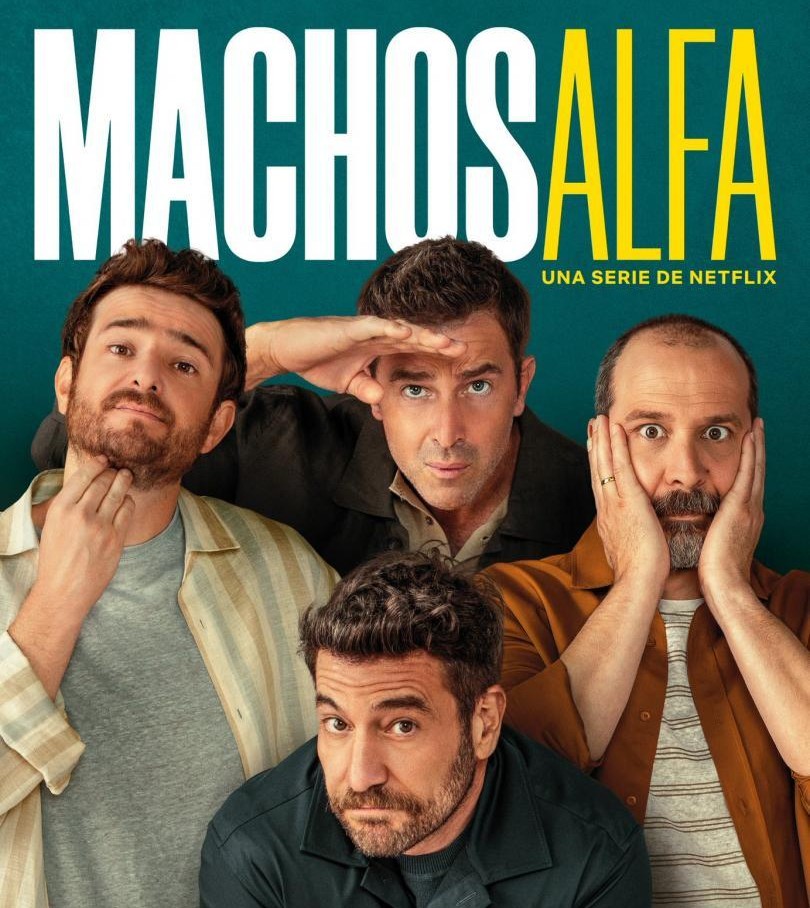
What a great feeling it was last night when I started watching (what I thought was) the first episode of the latest series of Machos Alfa on Netflix.
I love that show. I remember watching it when it first came out at the back end of 2022. It's great for me because it's in Castilian Spanish, from Spain, where I live. So the accent, the slang, the colloquial terms are all really familiar. Even the little cultural references are understandable to me now. Unlike when I first moved here, and for many, many years afterwards.
Which reminds me of a phrase I've often said during my time here in Spain: "el idioma es solo una pieza del puzle."
And I genuinely stand by that.
What may come across as rude and abrupt is actually an effective method of communication, depending on the tone and mannerisms with which it's delivered, of course.
The Imperative Problem
I'm referring there to the imperative form (el imperativo, as we call it here), which is used all the time in Spain.
"Ponme un café."
"Baja el volumen."
Although these phrases sound at first like they're loaded with directness (the likes of which us overly polite Brits would only ever hear when we're in trouble) they don't land well on the ear when you're not used to them.
But over time, you come to realise that saying "ponme medio kilo de estos" whilst pointing at some ripe bananas in the frutería gets you a lot further, and more quickly, than dancing around the request as it would be seen in the UK.
I spent years trying to maintain my Englishness here.
"Si me pones medio kilo de estos plátanos, si no te importa, cuando puedas, por favor, te lo agradezco mucho, mil gracias por ayudarme." Which means…
"If you could give me half a kilo of these bananas, if you don't mind, whenever you can, please, I'd really appreciate it, thank you so much for helping me."
By the time I'd said all that (and I'm not joking, I did use to speak like that!), I'd lost my place in the queue.
I eventually learned that overcomplicating things and trying too hard to speak Spanish in an English way went against the grain of communication here. I was always a fish out of water at the best of times, but I was swimming against the Spanish tide with my inability to accept how people here communicate and connect with each other.
I spent several years being super angry about it, in fact. Angry at the directness, angry at the cultural differences, angry at myself for not getting it. I even did a whole stand-up routine about it in 2020, venting my frustrations to a room full of expats in a comedy club in La Latina, Madrid. Very therapeutic at the time, but it did little for my eventual acceptance and willingness to finally embrace this country, its culture, and of course, its language.
The Accidental Benchmark
But last night, something happened that made me realise how far I'd actually come.
I thought I'd hit play on the new series, but a few minutes in, I realised there was something familiar about what I was watching. And I was right. It was the opening scene of episode 1, season 1. Where they're in the machirulos workshop, admitting to being "machistas" — a joke and cultural concern I never would have understood at the start of my language learning journey in 2011.
Aside from that, what was incredibly enlightening was how much I could understand this time around.
I've talked about this on my podcast before: watching familiar TV shows and films again and again helps boost vocabulary retention because you're not focusing on what's happening in the scene or who the characters are — your brain already has that information. Your mind, therefore, is free to pay attention to the words themselves. The phrases, the nuances, the intonation, the natural rhythm of how people actually talk to each other.
I've said this before, I know. But this was different.
This wasn't Friends or The A-Team — shows I know off by heart and could recite in my sleep. This was a Spanish TV show I'd seen once, three years earlier, with subtitles on and occasional requests for help decoding the in-jokes.
Last night, though, as I watched it again, I was blown away by the fact that I could follow and engage with almost all of what was being said.
Subtitles were on, yes. But I quickly noticed that I didn't need them.
There was a night-and-day comparison of improvement in my comprehension. I was so excited I carried on watching the episode I'd stumbled on by accident. The one I'd already seen. Not to remind myself of the plot, but to wallow in the sense of self-pride and achievement of what I was witnessing.
I hadn't taken any Spanish classes since I first saw this. No grammar exercises, no deeply confusing memorisation of conjugation charts, no mind-bendingly complicated attempts to understand and use the dreaded subjunctivo.
No. This was pure, undeniable progress.
Your Words, Your Way
It's only looking back that you're able to notice how far you've come. What's changed and developed in the way you are.
When you accidentally stumble across a piece of media (a book, a TV show, a song, a podcast) that you'd heard before when it was mostly white noise, and suddenly the fog has cleared and you can fully understand it? That's when you feel it. The payoff of your efforts. The proof that you've actually moved forward. Not because someone pointed it out or you had to pass an exam.
But because you felt it yourself.
And this is what I notice with the professionals I work with on English confidence too. Progress rarely announces itself.
There's no certificate, no test result, no moment where someone officially tells you that you've improved. Instead there's a meeting where you realise you hadn't rehearsed a single sentence beforehand. A conference call where you forgot, just for a moment, that you were speaking your second language. A presentation that went well, and you're not entirely sure why, except that something felt different this time.
The benchmark isn't a native speaker. It was never a native speaker.
It's you, from six months ago, sitting in a room where the language felt like a wall rather than a door.
I wasn't looking for proof, but there it was anyway, in a Spanish sitcom I'd already seen, subtitles I didn't need, and a feeling I couldn't quite name but didn't want to lose.
_________________________________________________________________________________________________
If this resonates, I've been exploring how language, mindset and identity shape the way we speak English on my podcast, From Lost to the River. You can listen at procoachenglish.com/podcast (by CLICKING HERE) and on all major streaming services as well as YouTube.
And to learn more about working together, you'll find everything HERE.