This website use cookies to ensure you get the best experience on our website
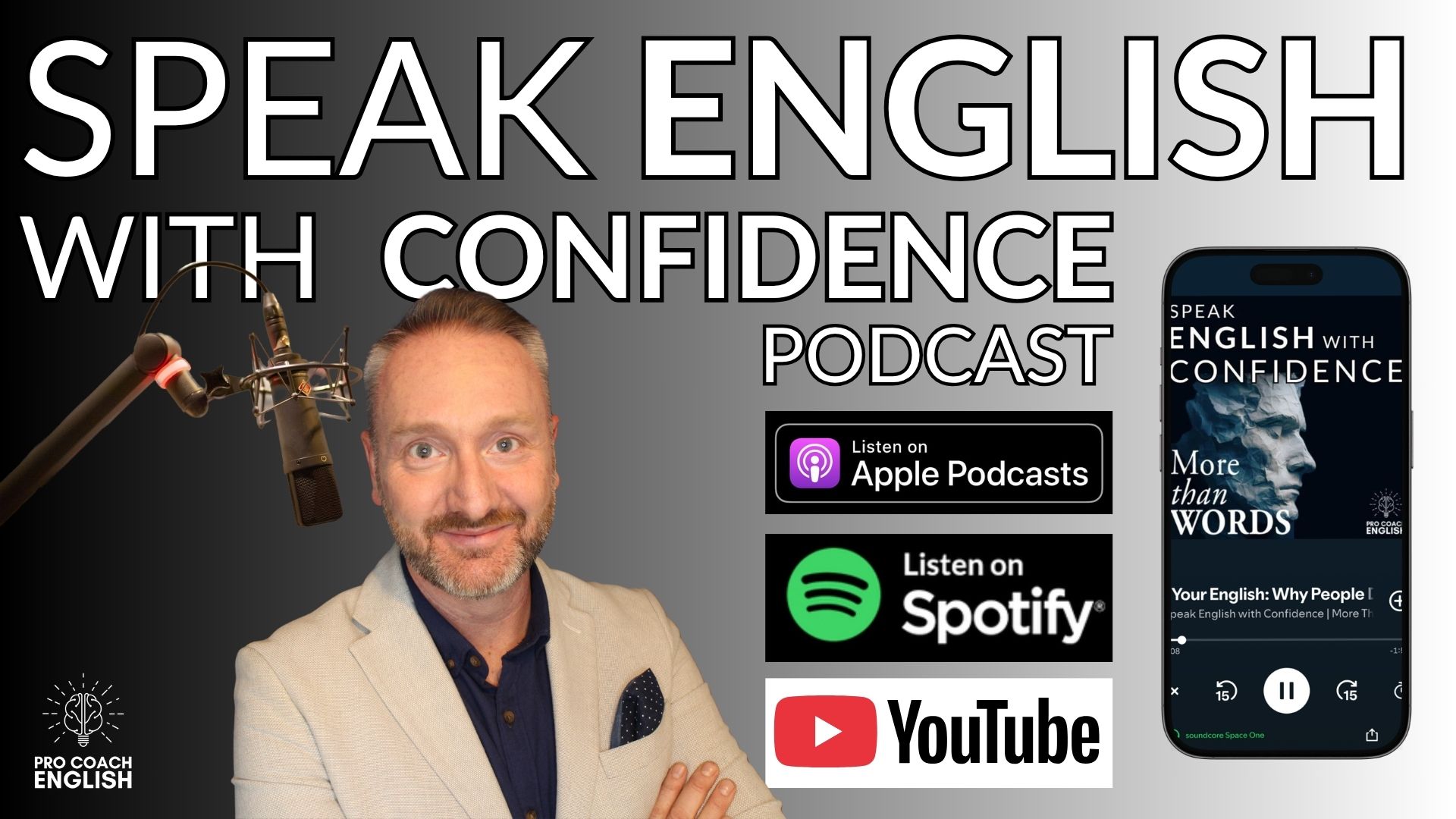
English confidence coaching for people who already speak the language but freeze when it matters most. This podcast is for anyone who is done with grammar exercises and ready to understand what is actually stopping them from speaking.
I am Richard Marshall, and on each episode of Speak English with Confidence | More Than Words (formerly From Lost To The River), I explore why capable, intelligent professionals go silent in meetings, presentations, and high-pressure conversations, and what actually moves them forward. Expect honesty, psychology, and real conversations with people who have been there.
If you have ever felt smaller in English than you do in your own language, you are in the right place. Streaming on all major podcast streaming services and on my YouTube channel. Check out the clips below for a taster.
How To Build English Fluency Without Studying
Building English fluency without sitting down to study is simpler than most professionals think, and one of the most underrated ways to do it is to listen to podcasts on topics you actually care about, because when your attention is on the subject rather than the language, your unconscious mind quietly absorbs vocabulary, intonation, and rhythm in a way that formal study rarely manages. In this clip I explain why passive listening works so well for professionals who want to speak English more confidently at work. I have done the hard work for you — fill in the contact form HERE and I will send you my personal podcast recommendation list, organised by subject.
Why Fluent Professionals Still Freeze When Speaking English at Work
English confidence for executives is rarely just about grammar, and if you have spent years studying it and still go quiet in meetings, then you already know that something else is going on. You know the language. The problem is that you do not feel like yourself when you speak it, and that gap between who you are in Spanish and who you become in English is not a knowledge problem, it is a confidence problem. If you have ever felt like a reduced version of yourself the moment you switch languages, this clip is for you. Read the full blog post HERE.
How I Overcame My Fear of Speaking a Second Language (And How You Can Too)
English confidence coaching works because the mindset comes first. Get that right, and the method has somewhere to land. I know what it feels like to have the words stuck in your head and no way to get them out. For years I avoided speaking Spanish, hated my accent, worried about mistakes, stayed quiet rather than risk getting it wrong. This clip is about what changed. I am now speaking Spanish on camera, imperfect and unbothered, because the point is getting across and that is what actually matters. If you are a professional who knows English but keeps yourself quiet to avoid embarrassment, this clip is for you.
Why Perfectionism Is Killing Your English Confidence (And How to Fix Your Mindset)
Overcome English perfectionism at work and something shifts. Perfectionism is one of the most common reasons professionals stop themselves from speaking English at work. In this conversation, author and mindset coach Ben Eden shares a simple but powerful reframe: instead of waiting until you feel confident, act like the person who is already there. Progress is progress, no matter the size, and when you start measuring yourself differently, everything changes. If you have ever left a meeting wishing you had said more, this conversation is worth your time.
Why Your Brain Lies to You Before You Even Open Your Mouth
Speaking English confidently starts before you open your mouth, and so does the fear that stops you. Before you have said a single word, your mind has already decided how it is going to go wrong. In this clip, Richard unpacks the psychology behind why professionals freeze before they speak: the fear of being misunderstood, the fear of looking foolish, and the story we tell ourselves that feels completely real but isn't. F.E.A.R. False Evidence Appearing Real. If you have ever walked away from a conversation thinking you failed, only to realise nothing actually went wrong, this one is for you.
Why Senior Executives Struggle to Speak English at Work (Even When They're the Most Qualified in the Room)
Speaking English confidently at work gets harder, not easier, when you reach the top. Something specific happens to professionals at the highest level of their careers when English enters the room. They have built their identity around authority, expertise, and the respect of their teams, and suddenly younger colleagues are more comfortable in the conversation than they are. This clip gets into why that happens: the difference between the professional who just gets in the pool and communicates, and the one still paralysed by a school system that taught them English was about getting it right, not getting it across.
Stop Blaming Your English. Even Native Speakers Say "Sorry, What?"
English anxiety at work is more common than you think, and it has nothing to do with how much grammar you know. If you freeze when speaking English or panic when someone says "Sorry, what?", this will help you rethink what is actually happening. Even native speakers mishear each other constantly. They repeat, pause, adjust rhythm. Struggling in those moments does not mean your English isn't good enough. In this conversation, language coach Daniele Ponzo breaks down the real communication habits that help professionals speak English confidently at work: intonation, strategic pauses, gestures, rhythm, and natural flow. These are the skills that reduce English anxiety and stop you from translating in your head before you speak. If you want to communicate with more presence and ease, start here.
Why Confidence Beats Perfection in English | COO of Toys R Us Spain
English confidence for executives. Sometimes the most powerful proof comes from someone who has lived it at the highest level. Miguel Ángel Carrasco Delgado, COO of Toys R Us Spain, spent over 30 years learning English while building a career across multinational companies. In this conversation filmed entirely in Spanish, he talks about fear, perfectionism, and why the most important thing you can do in English is simply say something, even when it isn't perfect. One of the most honest conversations about language confidence you will hear from someone who has been there.
Your English Is Better Than You Think | Shawshank Redemption Proved It
Speaking English confidently is easier when you can see how far you have already come, and most professionals who struggle with English confidence at work have no idea how much progress they have actually made because they are too close to it to see it. One evening I came home and Shawshank Redemption was on in Spanish. I couldn't change the language back. And sitting there following every word without subtitles, I had a thought that completely changed how I help my clients measure their English fluency, because the progress is real, it is just invisible when you are inside it. Read the full blog post HERE.
Why Speaking a Second Language at Work Makes You Doubt Yourself (And What To Do About It)
The fear of sounding incompetent in a second language is something most professionals never talk about out loud, and Sarah Smit knows exactly what that feels like. A polyglot and fluent Dutch speaker, Sarah learned the language as an adult professional in a country where almost everyone already speaks perfect English, which meant every conversation was an asymmetric situation where switching to English was always the easier option being offered to her. In this clip she talks about what it actually takes to build confidence in a second language when your professional credibility feels like it is on the line every time you open your mouth, and why the self-doubt that comes with speaking imperfectly in a professional context hits some people right in the core and others somewhere altogether more manageable.
Why They Can't Hear You (Even When Your English Is Good)
Speaking English confidently at work gets harder when the person in front of you has already decided they won't understand you before you've finished your first sentence. If you've ever frozen because of that face of confusion, the one that says this is going to be difficult before you've even got going, language expert and copywriter Lauren Martin shares something a Chinese friend told her that sparked a theory I've been developing, because sometimes the block isn't yours at all, it belongs to the listener. The ear on the other side just needs a little time to adjust. Keep going. Give them the chance to catch up.
Perfectionism, Accents, and Why Mistakes Are Fine
Language confidence at work rarely comes down to grammar. It comes down to how you handle the moment you get something wrong, and how quickly you can let it go rather than let it confirm everything you already feared about your English or your accent. In this episode I tell the story of the day I got one letter wrong at a butcher's in Spain and was laughed at by a room full of strangers, and what that taught me about perfectionism, the myth of the perfect accent, and why your accent is not something to apologise for, in any language, in any professional setting, ever.
Why Comparing Your English to Others Is Setting You Up to Fail
Speak like a native in six weeks. Fluent in two months. The promises that flood social media are not just unrealistic, they are actively damaging, and Verónica Vitale knows exactly why. Founder of Vital English and a language coach with over 20 years of experience helping Spanish-speaking professionals communicate confidently, Verónica joins me to talk about why comparing your progress to anyone else's, in language or in anything else, is comparing apples with pears, because nobody knows the history behind another person's fluency or what advantages got them there first. She shares what she tells her own students instead: forget the timeline, find content you would watch anyway, and let your brain catch up at its own pace, because it always does.
Your English Is Better Than You Think It Is (Even When You Call It "pichí pichá")
Imposter syndrome doesn't only show up in your career, it shows up every time you open your mouth in a second language, and Ángel Gabaldón knows it well. In this clip he tells me his English is "pichí pichá", his own self-deprecating phrase for a level that, by any honest measure, is excellent. We dig into why so many Spanish speakers judge their own English by a standard they would never apply to anyone else, the same mistakes that earn warmth and appreciation when a foreigner makes them in Spanish somehow become evidence of failure when the roles are reversed. A conversation about double standards, self-doubt, and why the person most convinced their English isn't good enough is usually the last to see how good it actually is.

How This Podcast Was Born
Most podcasts about learning English will teach you the present perfect, walk you through a phrasal verb of the day, or sit you down with a native speaker and ask you to repeat after them, and this one has never been that, from the very first episode.
It Started In A Training Room In Alcalá De Henares
On the outskirts of Madrid, I was running English classes for a group of senior professionals at Toys R Us, and on paper these were language lessons, but in practice they became something else entirely, weekly conversations where intelligent, experienced, successful people sat across from me and told me, in carefully constructed English sentences, that they felt stupid, and what I mean by that is not that their grammar was weak or that they needed more vocabulary, but that they felt small, like a different and lesser version of themselves the moment the language changed, and I heard versions of that same thing week after week until I stopped being surprised by it and started being curious about it instead.
The Damage The Schooling System Left Behind
What I came to understand, sitting in that training room four times a week, was that the Spanish education system had taught an entire generation of professionals that English was about getting it right rather than getting it across, and the result of decades of grammar exercises, fill-the-gap worksheets, and teachers who interrupted mid-sentence to correct a tense was a very specific kind of damage, one that had nothing to do with knowledge and everything to do with confidence, because these people could construct a sentence, they just couldn't trust themselves to say it out loud in a room where it mattered.
One of them told me she dreaded meetings where younger colleagues seemed more comfortable in English than she was, even though her technical level was higher. Another described the feeling of speaking English in front of a native speaker as sounding like a child rather than the senior professional she actually was. Another said his main goal had nothing to do with fluency, that what he wanted, more than anything, was simply to feel like the same person in English that he was in Spanish, and that one stayed with me for a long time, because that is not a language problem, that is an identity problem that happens to have a linguistic surface, and it was the moment I understood what I was actually being asked to help with.
Something Else Was Happening At The Same Time
I was driving to Alcalá four times a week listening to Spanish podcasts, not studying Spanish in any formal sense, just letting real conversations in on topics I actually cared about, neuroscience, psychology, coaching, the kinds of things I would have been listening to in English anyway, and I wasn't filling in worksheets or conjugating anything, I was just absorbing the language in a context where it felt natural and alive, and something was shifting, slowly and almost without my noticing, in the direction of feeling more like myself when I spoke, and less like someone performing a version of themselves they didn't quite believe in.
I started recommending English podcasts to my clients on that basis, not BBC Six Minute English, not a phrasal verb of the day, but real conversations on topics they actually cared about, and I watched what happened when they stopped studying English and started living inside it instead.
This Podcast Grew From Those Sessions
From the questions my clients asked me, the fears they named out loud, the breakthroughs I watched happen in real time when someone stopped trying to be correct and started trying to connect, and I started interviewing guests because I wanted professionals who struggle to speak English confidently at work to hear other people doing it out loud, imperfectly, and surviving, and more than surviving, because the fear of being misunderstood is almost always significantly worse than the reality of it, and the moment you stop performing your English and start using it, something changes that is very difficult to put back.
This Podcast Is For The Professional Who Has Spent Years Studying A Language They Still Don't Trust Themselves To Speak
Not because their English isn't good enough, and not because they need another grammar course, but because nobody ever told them that the problem was never the English in the first place, and that is what this podcast has always been about, from that training room in Alcalá de Henares to wherever you are reading this now.
This podcast is the argument and the evidence at the same time. If you listen and understand it, then your English is already better than you think it is.