Why Practising English in a Classroom Will Never Prepare You for a Real Meeting
By Richard Marshall
The Gap Nobody Talks About, and The Tool I Use To Close It
There's a specific kind of silence that happens in meetings, and if you've experienced it you'll know exactly what I mean.
It's not the silence of someone thinking. It's not a comfortable pause while ideas settle. It's the silence of someone who knows what they want to say, who has the vocabulary to say it, who has probably rehearsed a version of this conversation in their head at some point, and who is now completely frozen because the moment arrived unannounced and the English they've been practising in controlled conditions has simply disappeared.
I've sat across from senior executives, people who lead teams of hundreds, who manage budgets in the millions, who are completely authoritative in Spanish, and watched this happen. The knowledge is there. The preparation is there. But real communication under real pressure is a completely different environment from the one in which most English learning takes place, and nobody seems to be doing much about that gap.
So I started doing something about it.
The Problem With Prepared English
Most English learning happens in conditions that bear almost no resemblance to the situations where English actually matters.
You study in advance. You have time to think. You know what's coming. The vocabulary is pre-selected, the grammar is the focus, and the measure of success is correctness rather than communication.
And then you walk into a boardroom, or join an international call, or find yourself in front of an investor who asks you something you weren't expecting, and everything you've prepared becomes unavailable to you, because your brain is now operating under pressure rather than in the calm, controlled environment where all that preparation happened.
This is the gap. And it's not a grammar gap, or a vocabulary gap, or a pronunciation gap. It's a spontaneity gap, the difference between English you've had time to think about and English you need right now, with someone looking at you, waiting.
In every piece of research I've done with clients and professionals, not one person has said they feel confident before an important meeting in English. Not one. And I'd argue that's partly because most of the ways people try to improve their English don't actually train the thing that matters most in those moments: the ability to think and speak at the same time, under pressure, without preparation.
What I Do Instead
One of the tools I use with clients is something I call the Real Response Method™.
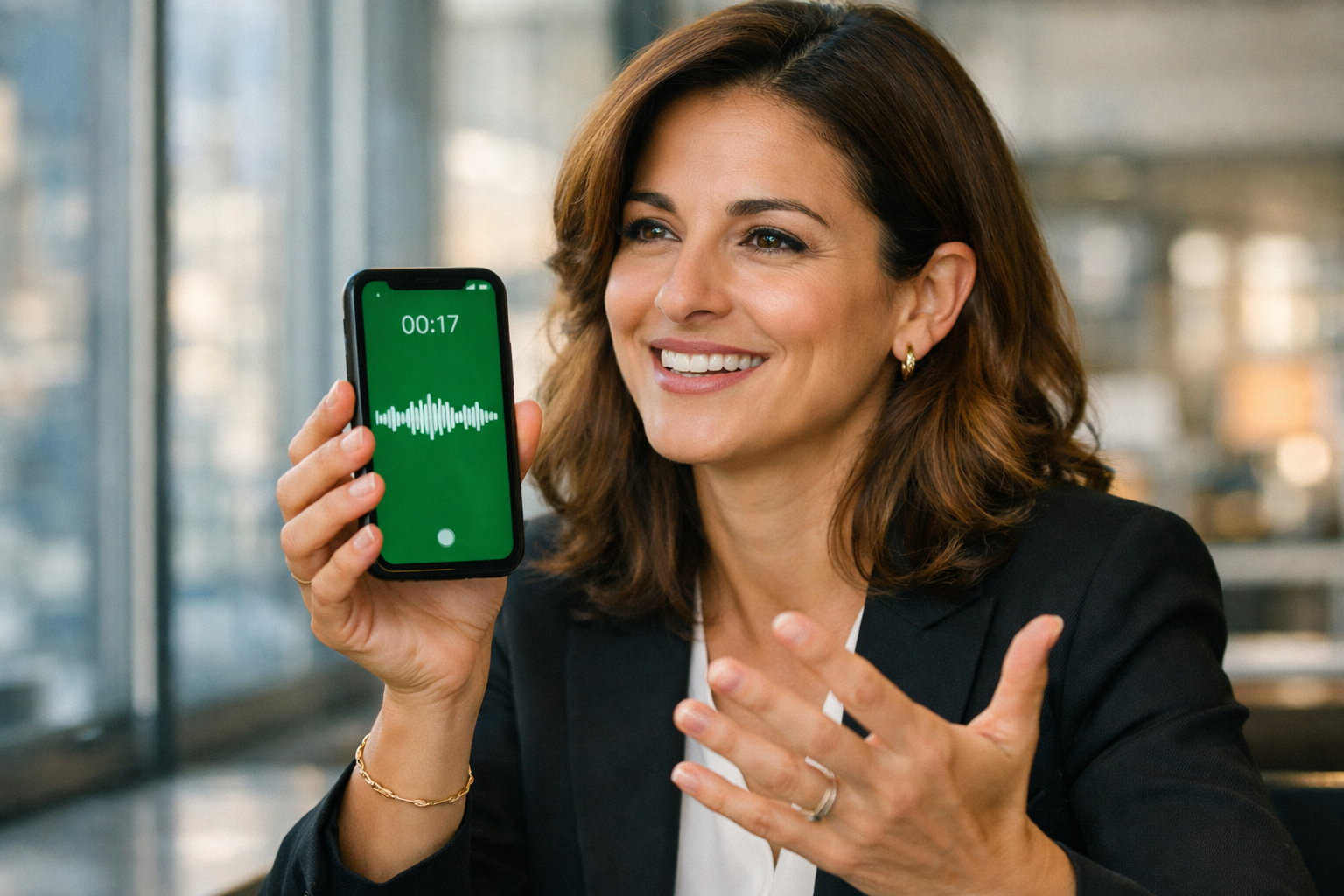
Rather than sending them articles to read or videos to watch, I send them a short WhatsApp voice note, something spontaneous and unannounced, a question, a comment, a reflection, the kind of thing a colleague or a friend might send you on a Tuesday morning without warning.
And they respond. Immediately. Without preparing, without rehearsing, without translating the answer in their head first and then speaking it.
That's it. That's the method.
It sounds almost too simple, and I understand why, because we've been conditioned to believe that learning has to be structured and effortful and formally organised to count as real. But what the Real Response Method™ is actually training is exactly what gets tested in every high-stakes English moment: the ability to receive something unexpected and respond to it clearly, naturally, and without freezing.
It replicates the reality of meetings and presentations, the unexpected question at the end of a presentation, the follow-up you weren't ready for, the moment someone asks you to clarify something you thought you'd explained clearly. There's no preparation time. There's no safety net. There's just you, and the language you actually have available to you under pressure.
And that turns out to be considerably more than most people think.
Why This Works
When you practise speaking under low-stakes spontaneous pressure, repeatedly and consistently, two things happen.
The first is that your response time improves. The gap between receiving a question and having something to say gets shorter, because your brain stops running the language through a filter of "is this correct?" before it allows you to speak. You stop second-guessing every word before it leaves your mouth.
The second is that your confidence changes in a way that prepared practice can't produce, because it's based on evidence rather than hope. You've responded spontaneously, in English, under pressure, and you were understood. Not because you got everything perfect. Because you communicated.
And communication, it turns out, is what every meeting, every presentation, and every high-stakes English moment is actually asking for.
Not perfection. Communication.
The Real Response Method™ is one of the tools I use as part of my work with clients. If you'd like to know more about how I work, you'll find everything at procoachenglish.com.
And if you want to understand more about the psychology behind why professionals freeze in English and what actually changes things, I've been exploring it on my podcast, From Lost to the River. You can listen at procoachenglish.com/podcast (by CLICKING HERE) and on all major streaming services as well as YouTube.
And you'd like to know more about working together, you'll find everything HERE.