Say Thank You. You Just Learned Something
By Richard Marshall
Last week a client sent me a WhatsApp message that ended with "depends of" instead of "depends on," which is one of those classic mistakes that makes complete sense if your first language is Spanish, because in Spanish the preposition goes the other way and the brain just reaches for the familiar one without asking permission first.
I corrected it the way I usually do, with a meme, something visual and light, the kind of thing that lands without weight, that says here's the right version without making the wrong version feel like a crime.
His response arrived within seconds.
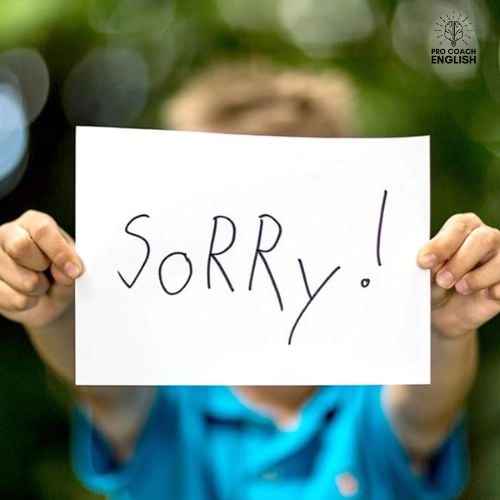
"Oh yes, sorry, I knew that. Sorry."
Two sorries. And between them, the three words that tell you everything: I knew that.
He wasn't apologising for not knowing. He was apologising for the slip, for the moment of imperfection, for being caught being human in a language he has been working on for years. The correction had landed, the lesson had taken about four seconds to absorb, and his immediate instinct was still to apologise twice for something he already understood.
Where the Sorry Comes From
I see this every week, and it has nothing to do with politeness and everything to do with what years of red pen education does to a person.
When you grow up in a classroom where every mistake is marked, catalogued, and handed back to you as evidence of inadequacy, you develop a reflex. The reflex says: when something goes wrong, manage it immediately, contain the damage, make clear that you know it was wrong before anyone else has the chance to point it out. The apology is pre-emptive damage control, and it arrives so fast that most people don't even notice they're doing it.
But here's what the sorry is actually communicating, to you and to anyone watching: that making a mistake in English is something to be ashamed of. That imperfection requires an apology. That the natural process of a brain reaching for the wrong preposition and being gently corrected is a failure rather than, as it actually is, the entire mechanism by which language learning works.
What I Tell Clients Instead
When someone says sorry after a correction, I gently pull them back. Not to make a point, but because letting it go without saying something would be a missed opportunity.
Say thank you, I tell them. You've just learned something, and that's worth acknowledging rather than apologising for.
It sounds almost too simple, and yet the fact that I find myself saying it so often tells me how deep the conditioning runs. These are senior professionals, people who lead teams and manage complexity and make decisions that affect hundreds of people every day, and their immediate instinct when a preposition lands in the wrong place is still to apologise, as though the mistake reflects on something far bigger than a preposition.
A child learning to ride a bike doesn't apologise for falling off. They get back on, or they don't, but either way the falling is understood as part of the process rather than a moral failure. Somewhere between the playground and the boardroom, adults lose that understanding entirely.
The Thing the Sorry Is Covering Up
What I've come to understand, working with professionals over many years, is that the sorry reflex isn't really about the mistake at all. It's about the story running underneath the mistake, the one that says: I should be better than this by now. I've been studying English for twenty years. I shouldn't be getting prepositions wrong. The fact that I am means something about my level, my intelligence, my right to be taken seriously in this language.
That story is wrong, and the sorry is its loudest symptom.
"Depends on" versus "depends of" is not a reflection of your intelligence. It is a reflection of the fact that Spanish uses a different preposition and your brain has spent decades wiring that in. Correcting it takes about four seconds and approximately one meme. It doesn't need an apology. It needs a thank you and a mental note, and then you move on and use the right one next time, and eventually you don't need the mental note either because it's just there, wired in correctly, no apology required.
The fastest way to improve your English is to stop treating every correction as a verdict on your worth and start treating it as information. Information is useful. Shame is not.
Next time someone corrects you, try it.
"Thank you".
Two words, no sorry, and see how different it feels to receive a lesson with genuine gratitude as opposed to a wounded student who's terrified of being wrong.
_________________________________________________________________________________________________
If this resonates, I've been exploring how language, mindset and identity shape the way we speak English on my podcast, From Lost to the River. You can listen at procoachenglish.com/podcast (by CLICKING HERE) and on all major streaming services as well as YouTube.
And to learn more about working together, you'll find everything HERE.
