The Crowd in Your Head Is Not the Room You're In
By Richard Marshall
How We Traded Warm, Human-Sized Approval for the Cold Gaze of Imagined Audiences
The Slideshow Nobody Asked For
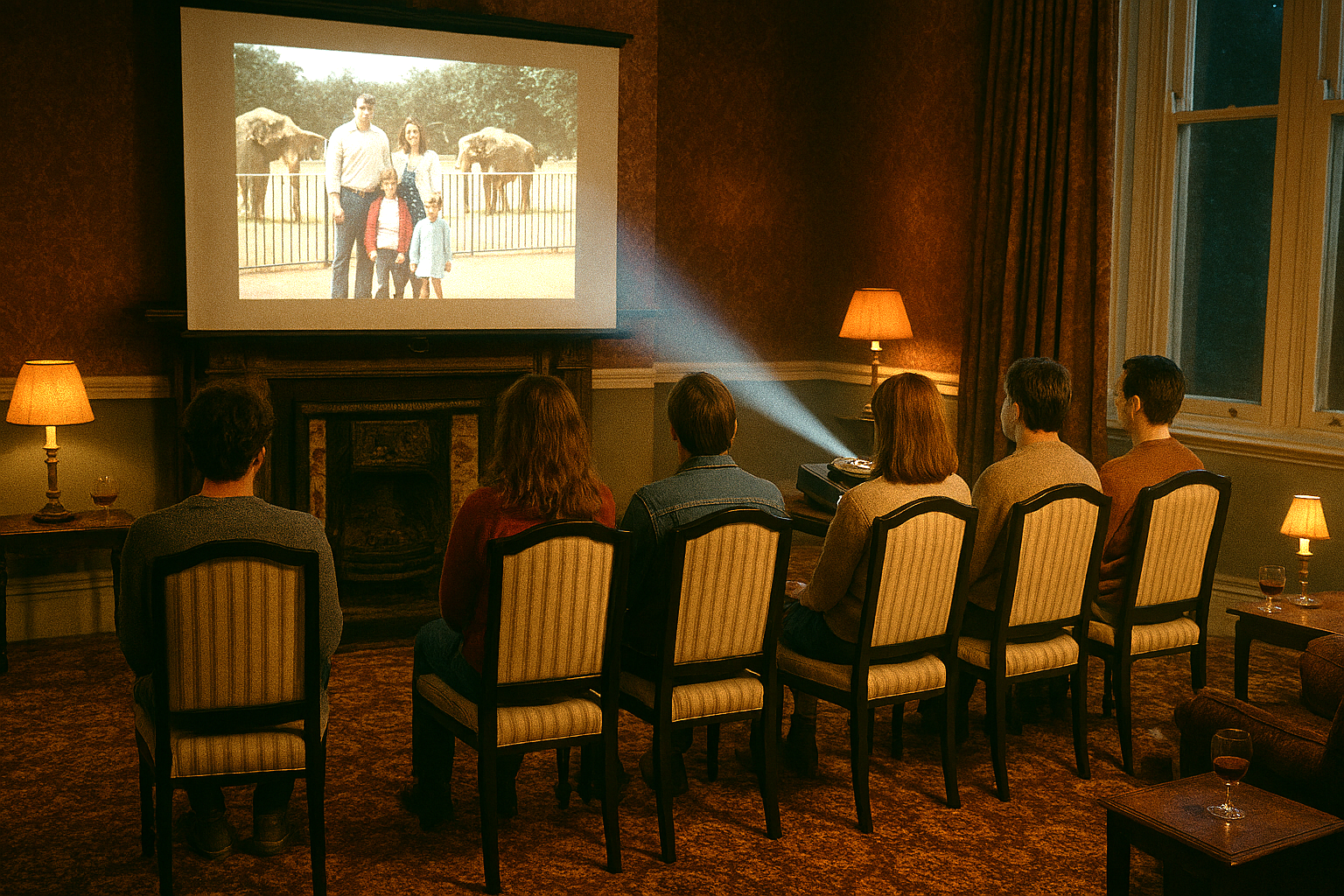
My dad had a projector, one of those big clunky ones that hummed when you turned it on, and a pull-down cinema screen that lived rolled up above the fireplace in the lounge. On certain Friday evenings in the eighties he would invite a handful of friends round, pour some wine, open a bag of crisps, and show them slides from our family holiday (a zoo in Scotland, as I recall, which in hindsight sounds bleak but at the time felt genuinely exotic because when you're from Blackburn, anything north of Preston feels like long-haul travel to a nine-year-old).
His friends sat there in our six dining room chairs, half-interested, half-drunk, asking the kind of polite questions people ask when they're too well-mannered to check their watch. And my proud father answered every single one of them with the glowing satisfaction a man gets when he has everything he needs (the attention of a few good friends who gave up a weekend night for some crisps and a boring slideshow and somehow still managed to enjoy themselves, and the deep satisfaction of knowing that the life he'd built was worth looking at).
That was it. That was the whole transaction.
Approval sought, approval gained, everyone went home happy (or at least nobody went home feeling like a failure, which in the current climate feels almost revolutionary).
When the Audience Got Infinite
The status game we played back then was small and local and entirely manageable, and I think that's worth sitting with for a minute. Because we don't talk about it enough, this idea that the size of your audience has a direct relationship with how you feel about yourself. And that somewhere along the way we went from showing our holiday snaps to six friends in a living room to broadcasting our entire lives to an infinite, invisible, algorithmically-curated crowd of strangers who are simultaneously being told, by the same machine that's showing them your content, that they're not quite good enough either.
And the machine has a preferred format for all of this, which is the listicle, the hack, the "three ways to be better at whatever you're currently failing at," the relentless, dopamine-engineered drip of content whose underlying message, when you strip away the motivational font and the stock photo of someone looking thoughtfully into the middle distance, is essentially:
"You're a bit broken, and here's how to get fixed."
- Be a better parent.
- Sleep better.
- Think better.
- Optimise your morning.
- Audit your habits.
The implication being, of course, that the version of you that exists right now, the one reading this on your phone at whatever time it is, is a rough draft that needs significant work before it's ready to be taken seriously.
I understand the appeal of improvement, I'm not arguing against it, but there's something especially corrosive about the way this particular machine delivers the message, because it's not actually interested in making you feel better, it's interested in making you feel just bad enough to keep scrolling, and the moment you actually feel good about yourself it's lost you, which is why it never quite lets you get there.
My dad never felt that. He showed his slides, he poured his wine, he went to bed.
The approval he needed lived on six chairs in his front room, and it was warm and specific and real, given to him by people who actually knew his name and had sat at his dinner table and would ask after his kids the next time they saw him.
And I think there's something in that smallness, that human-scaled intimacy, that we have catastrophically undervalued in our rush to build audiences we can't see, pouring our hearts out for strangers we'll never meet, on platforms that don't actually care whether we feel good or not, as long as we keep showing up.
· · ·
The Crowd That Doesn't Exist
I see a version of this every day, just with higher stakes and a different language. The professionals I work with have built careers and teams and reputations, they run things, they are trusted, and they go completely silent the moment English enters the room. When I ask them who they imagine is listening when they speak, they never describe the actual room they're in. They describe a crowd. An infinite, invisible audience made of native speakers, of imagined judges, of every classroom correction they ever received, every moment of hesitation that felt, in retrospect, like exposure.
That crowd never applauds. It just watches and waits for the mistake.
What's real is the six chairs: the colleague who already knows them, the client they've worked with for years, the boss who is already on their side, people who mostly just want to understand what's being said and get on with the rest of their afternoon. But somewhere between the reality of that room and the anxiety of speaking a second language under pressure, the crowd gets invented. And once it exists, it's very hard to uninvent.
What the Freeze Actually Is
This is the thing almost every client describes in the first session: the freeze. The moment where the English they absolutely do have just goes somewhere else entirely. And it has nothing to do with vocabulary or grammar. It's what happens when the imaginary audience gets too loud.
My clients aren't afraid of the six chairs. They're afraid of the crowd they've invented, the one they're performing for without realising it, the one whose standards can never quite be met because it was never designed to be satisfied. The inner critic, the perfectionism, the years of being corrected in classrooms, that's their algorithm. And like all algorithms, it's built to keep them reaching, never arriving.
Once you understand that, the work changes completely. Because the problem was never that they didn't know enough English. The problem was that they didn't trust the English they already had. And that's a different problem with a different solution.
Finding Your Six Chairs
My dad never worried about the infinite audience. He didn't know it existed. He had his slides and his wine and his six chairs, and that was a complete world, sufficient, warm, and exactly the right size.
What I do, in essence, is give people their six chairs back. I help them shrink the audience down to human scale. To swap the imaginary crowd for the actual room. To realise that the approval they're chasing, warm, specific, real, given by people who already chose to be there, was always available. They just couldn't see it through the crowd.
Six chairs and a pull-down screen was always enough. The crowd was never the point. And most of the time, if you look up and count the actual people in the actual room, you'll find there were never more than six chairs in the first place.
_______________________________________________________________________________________________
Katarzyna Ciszewska read the pre-launch manuscript on a train last week. Katarzyna runs Al Dente, one of the best practical Italian learning communities on Substack, where she writes about real engagement over perfectionism, which means she knows exactly what it feels like when the psychology of language learning gets it right.
Follow Katarzyna on LinkedIn HERE and subscribe to her Substack HERE.