Who Are You When You Speak English?
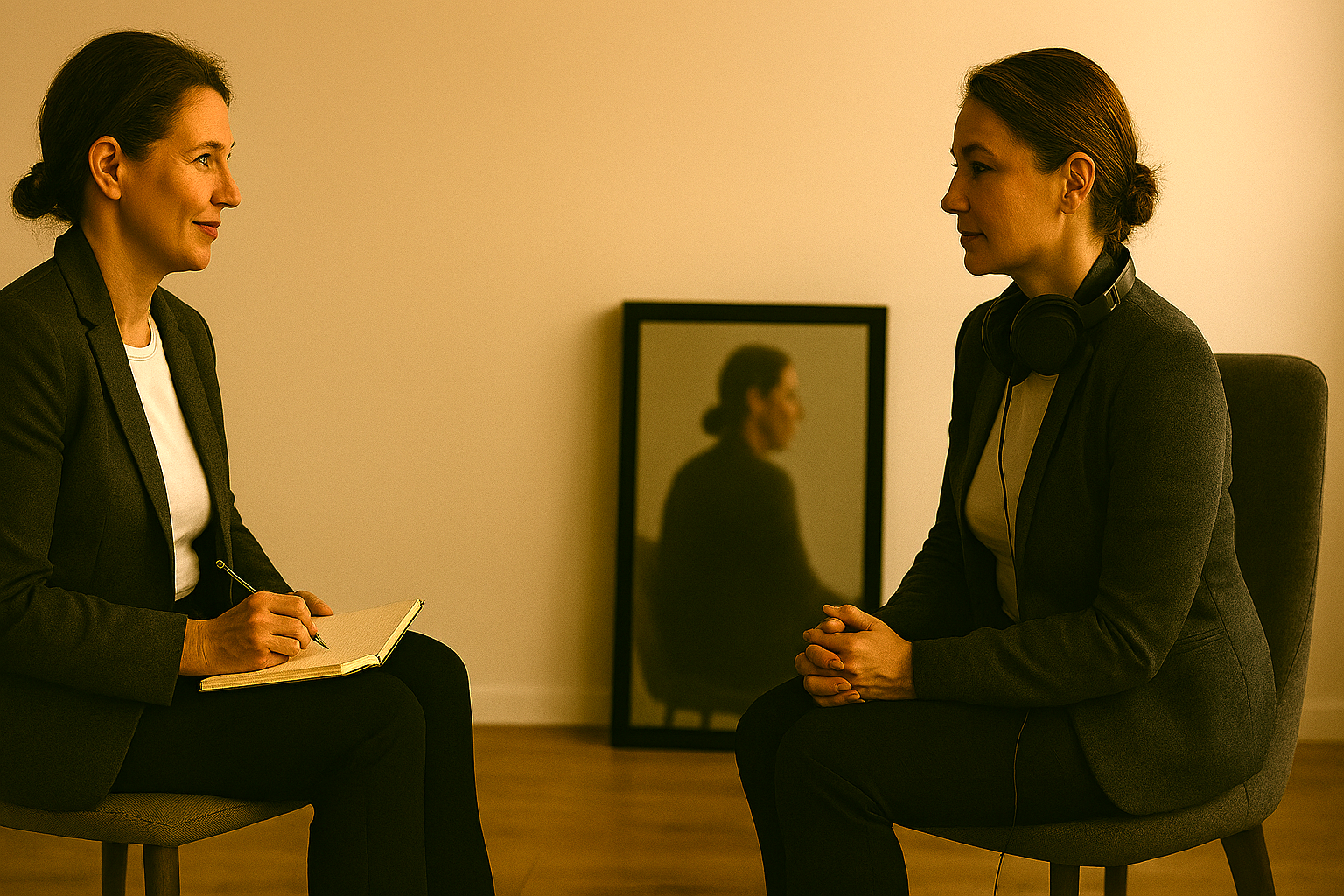
By Richard Marshall
When A Confident Executive Goes Quiet In English Meetings
Teresa is a COO who runs teams across several European countries and has been doing it for years in a language that isn't her own, and she told me recently that there are moments where she simply doesn't lead. She understands what's happening. She knows what she wants to say. But there's this little gap between certainty and almost-certainty, and that gap, small as it is, is enough to keep her quiet.
"Sometimes I don't want to ask," she said.
And I knew exactly what she meant.
The kid at the back of the classroom who understood the question but didn't put their hand up. The person in the shop who smiled and nodded instead of asking the assistant to repeat themselves. The professional who let the meeting move on rather than ask for clarification. Different scenarios, different phases of life, the same silence, and the same reason for it: asking feels like proof that I don't belong here.
When I asked Teresa to rate her confidence in English leadership situations from zero to ten, she said six, then corrected herself to six and a half almost immediately, because she remembered she'd been doing this in English for over two years and doing it well, and the six and a half had nothing to do with her English and everything to do with how she felt about herself when she spoke it.
That distinction is the whole thing.
Because what Teresa was experiencing in those meetings wasn't a language problem, it was an identity problem wearing a language problem's clothes, and it's the same thing I see every week with the people I work with, this gap between who you are in your own language and who you become when the language shifts, the slight dimming of the self that happens when the words you reach for don't quite carry the weight of what you actually mean, when the sentence you'd have delivered in Spanish with authority and ease comes out in English just slightly softer, slightly less yours, and you hear it landing differently than you intended and something inside you tightens.
The Phrase That Gave Her Authority Back
The phrase Teresa had been using in those moments of uncertainty was "sorry, I'm not sure I understand you correctly." In Spanish, that's perfectly reasonable. Culturally normal. The kind of thing you'd say without a second thought.
In English, in a leadership context, it lands completely differently. It opens with an apology. It puts the fault on her. It suggests to everyone in the room that she might not be following, which is the last thing a COO needs to be suggesting, in any language.
What I gave her instead was this: "Let's just stop things for a second, because I want to be clear on where we are here."
Same intention, no apology, no self-undermining, just authority.
She used it in a meeting the following week, with a colleague from Wales, and she told me afterwards that she watched him smile when she said it, and she didn't know why he smiled, but something in her that had been clenched finally let go, and she went home feeling, as she put it, lifted.
Not perfect, not fluent in the way she'd imagined fluency was supposed to feel.
Just lifted.
The confirmation that she'd been understood, that she'd held her ground, that she was more or less the same person in English that she is in Spanish, on a good day, which is all any of us can really ask for.
The Question Nobody Asks In A Language Class
I know this from the other side, because I stayed quiet for years in Spain, nodding along to conversations I didn't follow, too proud to admit it and too afraid to try, and the longer I waited to feel ready, the further away ready seemed to get, and what I eventually came to understand, working on my own Spanish and watching people work on their English, is that the question underneath all of it was never about vocabulary or grammar or pronunciation, it was always the same question, and it's the one nobody asks out loud in a language class:
Who am I in this language, and how do I bring more of myself into it?
Because the answer to that question is what changes everything, and being correct is beside the point. Being present is the whole thing. And the only way to find it is to stop waiting until it feels safe and start speaking from wherever you actually are, which is almost always further along than you think.
_________________________________________________________________________________________________
If this resonates, I've been exploring how language, mindset and identity shape the way we speak English on my podcast, From Lost to the River. You can listen at procoachenglish.com/podcast (by CLICKING HERE) and on all major streaming services as well as YouTube.
And to learn more about working together, you'll find everything HERE.